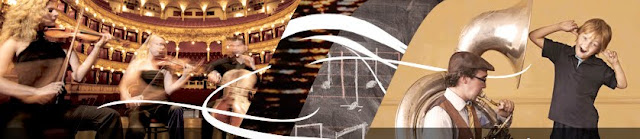
The Borodin Quartet's history is well known - founded in 1945 by four students from the Moscow Conservatoire, their remarkable history includes working with Dmitri Shostakovich on every one of his quartets, and performing on the same day at the funerals of both Stalin and Prokofiev.
According to Musica Viva's Artistic Director, Carl Vine, although no current members were present at the Borodin Quartet's birth, the group carries with it a staggering weight of musical and social history. Each member of the quartet is a graduate of the Moscow Conservatoire, even learning from the same small branch of teachers. Violinist Ruben Aharonian explains, "if you listen to the same work played by the Borodin Quartet as compared to any other quartet, European or American, you feel immediately - not because the Borodins play better - but you feel the difference in sound, in phrasing. The Borodins have their own way of playing, their own musical vision, their own interpretation." Igor Naidin, viola, agrees. "The Borodin Quartet definitely belongs to this famous Russian school of string-playing. It's the way of performing."
The repertoire of the great Russian composers, such as Shostakovich, Prokofiev, Borodin and Tchaikovsky, has become the hallmark of the Borodin Quartet. Traditions and knowledge, such as that imparted by the early members' work with Shostakovich, are accumulated and passed on. As each member arrives in the group, they study the traditions of the previous members.
Audiences and critics alike seem to pick up on this continuity. The Telegraph's Ivan Hewitt writes "cultural memory is a tenacious thing. Sitting in the Wigmore Hall, listening to the Quartet play Shostakovich's First and Eighth Quartets, it was impossible to resist an uncanny sense of being taken back to the root of something. You could say this was just the magic effect of a near-mythical reputation, but there is something special in the Borodin Quartet's sound which would persuade even an innocent listener. It's the refusal to exaggerate, and a pearly, immaculate quality in the balance of the four parts." Geoff Brown, of the Times, concurs. "The group's tonal characteristics continue. There's that precious ensemble sense and the clarity and subtlety of textures, shadings and phrasings."
This is not to say their performances are static or unchanging. According to Carl Vine, the group's interpretations continue to develop and evolve, propelling the ensemble to the peak of the world's finest. Naidin claims that tradition and rejuvenation should always be well balanced. In revisiting a work the quartet will draw on prior knowledge and memories of past performances, but if something does not feel right they are not averse to refreshing those ideas.
Whatever one's opinion of the Borodin Quartet's history, the quality of the group's current line up seems undisputed. Andrew Stewart in Classical Music Magazine wrote recently of the group's "special qualities, the finely judged balance of precision and spontaneity, the searching artistry of an ensemble implacably opposed to the routine and superficial. They stand for music making for adults, totally serious in intent and free of gimmickry." Indeed, the group is renowned for its total engagement with the music and complete lack of vanity in their playing. Geoff Brown claims "the most compelling attributes of the Borodin Quartet are their homogeneity as an ensemble and their pure, gimmick-free playing," while Agnes Kory comments on their "admirable ensemble work."
Musical qualities and characteristics can be difficult to put into words. Perhaps Andrew Stewart sums it up well. "The group's technical precision and tonal warmth, the rigour and depth of its interpretations, and the near telepathic communication skills speak volumes about its artistic pedigree."
Check out Musica Viva's website www.musicaviva.com.au for Borodin Quartet concert dates, ticket information and our new Concert Insights page featuring Online Concert Talks, free Concert Guides and more!
Wednesday, February 10, 2010


Tuesday, February 9, 2010
The Borodin Quartet has landed
Arriving in Sydney Airport last night the Borodin Quartet said they were glad to be back in Australia and that it feels like they never left. Prior to the tour the Quartet's violist, Igor Naidin, told us that Australian audiences are among "the best, most welcoming and outstanding audiences. This tour will be the highlight of 2010 for us, definitely. We only wish that the quartet would appear more often in Australia." The Quartet is looking forward to the warm Australian weather and is now resting before beginning their 10 concert tour.
Monday, February 8, 2010
Edward Seckerson, "Borodin Quartet, Wigmore Hall", The Independent (Online), UK
"The Borodin Quartet brings a lot of history to the table – 60 years, to be precise. Personnel may come and go, the balance of personalities may shift, but the identity remains resolutely intact.
Perceptions have changed immeasurably since the unforgettable candelight vigil of the last Shostakovich quartet in their legendary London cycle of the 1980s – none of those players are still with us – but this composer is still their collective signature and they play him with a very particular authority, as if the hotline to his every thought it still very much open."
http://www.independent.co.uk/arts-entertainment/classical/reviews/borodin-quartet-wigmore-hall-1863587.html
http://www.independent.co.uk/arts-entertainment/classical/reviews/borodin-quartet-wigmore-hall-1863587.html
Borodin Quartet arrives Sydney 9 February 2010
The Borodin Quartet arrives from Moscow in Sydney tonight (!) They are in Australia for the next three weeks performing in the capital cities. Watch out for media interviews over the next couple of days and concerts starting from this Friday.

BORODIN QUARTET (MOSCOW)
“You have to be deeply in love with the string quartet as a form in order to live the life of a string quartet.”
Igor Naidin, violaRuben Aharonian, violin
Andrei Abramenkov, violin
Igor Naidin, viola
Vladimir Balshin, cello
The Borodin Quartet considers the string quartet the most beautiful way to make music. Throughout the group’s illustrious career its unique identity has been closely linked with the so-called ‘Russian school’ of string playing. All of the group’s members studied at the Moscow Conservatory, absorbing this method as it evolved across the generations.
Formed in 1945, the Quartet’s remarkable history includes working with Dmitri Shostakovich on every one of his quartets, and performing on the same day at the funerals of both Stalin and Prokofiev.
Subscribe to:
Posts (Atom)


 Posts
Posts

